
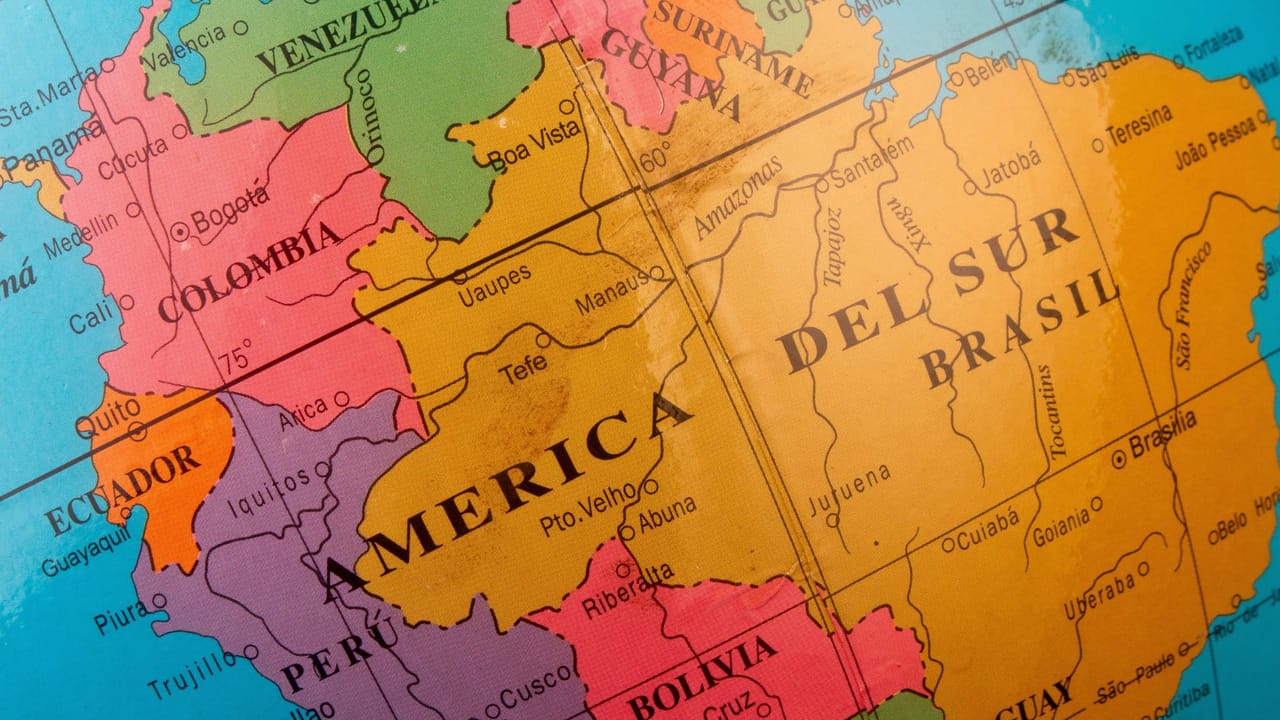
- What: State-sponsored cyber operations targeting Latin America
- Impact: Government entities and nations in the region are under threat
Informa TechTarget | SearchSecurity Cybersecurity Dive InformationWeek Channel Dive Explore our brands Dark Reading Resource Library Black Hat News Omdia Cybersecurity Advertise NEWSLETTER SIGN-UP Cybersecurity Topics World The Edge DR Technology Events Resources CYBERATTACKS & DATA BREACHES CYBER RISK THREAT INTELLIGENCE CYBERSECURITY OPERATIONS NEWS Breaking cybersecurity news, news analysis, commentary, and other content from around the world, with an initial focus on the Middle East & Africa and the Asia Pacific Tropical Blend: Cyber & Politics Ramp Up Across Latin America China-linked espionage groups have attacked at least a dozen nations in the region, gathering information on maritime shipping, oil production, and other geopolitical interests. Robert Lemos,Contributing Writer June 3, 2026 4 Min Read SOURCE: JHONNY MARCELL OPORTUS VIA SHUTTERSTOCK State-sponsored threat groups have increased their cyber operations targeting countries and government entities in Latin America and the Caribbean, as the US and China take a more active geopolitical role to the region. Following the US military operation in Venezuela, China-linked group FamousSparrow targeted a Venezuelan governmental group focused on maritime affairs, cybersecurity firm ESET stated in an report on advanced persistent threat (APT) groups released May 28. Both FamousSparrow and NegativeGlimmer — another China-linked cyber-espionage group — targeted government agencies in Panama as well. The two countries are only the most recent Latin American nations targeted by China in the past year. ESET has tracked about a dozen targeted countries in the region since early 2025, says Alexis Rapin, a cyber threat analyst with ESET. While the overall strategy may be from the PRC's national playbook, many China-linked groups operate according to their sponsoring organizations, he says. Related:Latin American Cybercriminals Hoover Up Government Data "PRC intelligence system is very decentralized, with many intelligence units reporting firstly to provincial authorities," Rapin says. "In this context, it's quite conceivable that two different APT groups may be tasked with targeting the same entity, because it proves strategic to various regions or departments simultaneously, without any coordination taking place between them." Geopolitics has focused major nation-states on the Latin America and Caribbean region. The US military operation to capture the president of Venezuela and his wife and the Trump administration's vow to "take back" the Panama Canal are among the US-China points of tension that may spur additional cyber activity, experts say. China holds claims to about half the oil produced by Venezuela, and the Chinese company that held the contracts to operate ports on both sides of the Panama Canal — the Panama Ports Company, a subsidiary of the Hong Kong-based conglomerate CK Hutchison — lost its contract when the country's Supreme Court ruled that the agreement violated Panama's constitution. Oil and Shipping Drive China's Interest With the Trump administration's "aggressive reaffirmation of US interests in the region," China is looking to gather intelligence on what's being discussed behind closed doors and whether their economic and geopolitical interests are threatened, ESET's Rapin says. "It's pretty clear that oil constitutes one of China's primary interests in Venezuela, and it thus seems fair to assume that this in turn constitutes one of the major motivations behind China-aligned APT activities in the country," he says. Related:China's 'FamousSparrow' APT Nests in South Caucasus Energy Firm State-sponsored attacks focus overwhelmingly on government agencies in North and South America. Source: ESET A variety of APT groups are active in the region. China-linked Earth Krahang, for example, targeted Mexico, Brazil, and Paraguay in 2024, and groups such as Vixen Panda, Aquatic Panda, and Liminal Panda have targeted Argentina, Bolivia, Brazil, Chile, Colombia, Ecuador, Peru, Suriname, and Uruguay in 2024 and 2025. The groups typically are not using zero-day exploits, but a toolbox of common tactics, says Santiago Rosenblatt, CEO and founder of security vendor Strike.sh. "Identity-led intrusion paths — [such as] phishing-resistant multifactor authentication (MFA) gaps, conditional-access bypasses, [and] post-MFA token theft — are now the most commonly scoped-up area, especially in financial services and gov-adjacent fintechs in Mexico, Brazil and Argentina," he says. "Second, edge-device and API-surface testing demand has spiked." Russian cyber-espionage groups are mostly absent. However, while Russia's cyber-operations have mainly targeted Ukraine and its allies, Cuba has always been of interest to Russia, and the Trump administration's recent focus on the island nation will likely spur additional cyber activities. Patch Those Servers The most frequent initial access technique involved the compromise of an unpatched server — often a Microsoft SQL database or Exchange mail server, ESET says. While nation-state adversaries have certainly deployed zero-day exploits, the threat actors usually try to avoid using more advanced implants and techniques unless absolutely necessary, says Mathieu Tartare, a senior malware researcher at ESET. Related:Middle East Cyber Battle Field Broadens — Especially in UAE "On several occasions we detected the deployment of custom implants after the failed deployment of off-the-shelf implants," he says, adding, "Properly patching such servers should be the highest priority." The second most popular form of access is spear-phishing, as demonstrated by the NegativeGlimmer attack, he says. Strike.sh's Rosenblatt agrees. Organizations should focus on identity by putting phishing resistant MFA on every privileged account, and patch Internet-facing edge devices within 14 days, especially if they are on CISA's Known Exploited Vulnerabilities list, he says. "Mandiant's 2024 finding, the four most-exploited vulnerability classes were all in edge devices, is the single most operationally relevant data point" in reports, he says. "This is the door PRC-aligned actors have walked through into LatAm governments more often than any other." Read more about: DR Global Latin America About the Author Robert Lemos Contributing Writer Rob is an award-winning, veteran technology journalist of more than 30 years, reporting on global cybersecurity issues, the latest offensive and defensive technologies, malware incidents, cyber conflict, and AI's impact on software and cybersecurity. A former research engineer, Rob has written for more than two dozen publications, including CNET News.com, Dark Reading, MIT's Technology Review, Popular Science, and Wired News. He has received five awards for journalism, including Best Deadline Journalism (Online) in 2003 for his coverage of the Blaster worm. Rob also analyzes data on various trends using Python and R for both his reporting and his clients. Recent reports include analyses of the shortage in cybersecurity workers, annual vulnerability trends, and annual threat reports. Rob holds degrees from Cornell University in Electrical Engineering and Computer Science (double major). Want more Dark Reading stories in your Google search results? ADD US NOW More Insights Industry Reports How Organizations Are Managing Incident Response How Enterprises Are Developing Secure Applications Inside RSAC 2026: security leaders reveal the risks redefining your defense strategy Essential News & Insights from Black Hat USA 2025 How Enterprises Are Harnessing Emerging Technologies in Cybersecurity Access More Research Webinars The Frontier AI Era: Why Cybersecurity Must Move at Machine Speed Build vs. Buy: The Hidden Cost of Building Your Own AI Security Stack Defending in the Shadow Era: When the CVE Feed Goes Dark Building SecOps That Make the Most of Every Dollar AI-Powered Cybersecurity for Resource-Constrained Organizations More Webinars You May Also Like CYBERATTACKS & DATA BREACHES Critical Fortinet Flaws Under Active Attack by Jai Vijayan, Contributing Writer DEC 17, 2025 CYBERATTACKS & DATA BREACHES CISA Warns of 'Ongoing' Brickstorm Backdoor Attacks by Rob Wright DEC 04, 2025 CYBERATTACKS & DATA BREACHES F5 BIG-IP Environment Breached by Nation-State Actor by Alexander Culafi OCT 15, 2025 CYBERATTACKS & DATA BREACHES Jaguar Land Rover Shows Cyberattacks Mean (Bad) Business by Robert Lemos, Contributing Writer OCT 03, 2025 Editor's Choice CYBERSECURITY OPERATIONS 20 Leaders Who Built the CISO Era: 2 Decades of Change byDark Reading Editorial Team MAY 12, 2026 41 MIN READ APPLICATION SECURITY It's Patch Tuesday for Microsoft & Not a Zero-Day In Sight byJai Vijayan MAY 12, 2026 5 MIN READ CYBERATTACKS & DATA BREACHES Instructure Breach Exposes Schools' Vendor Dependence byAlexander Culafi MAY 6, 2026 4 MIN READ Want more Dark Reading stories in your Google search results? Keep up with the latest cybersecurity threats, newly discovered vulnerabilities, data breach information, and emerging trends. Delivered daily or weekly right to your email inbox. SUBSCRIBE Webinars The Frontier AI Era: Why Cybersecurity Must Move at Machine Speed TUESDAY, JUNE 23, 2026 1:00 PM EDT Build vs. Buy: The Hidden Cost of Building Your Own AI Security Stack THURS, JUNE 25, 2026, AT 1PM EST Defending in the Shadow Era: When the CVE Feed Goes Dark TUES, JUNE 16, 2026 AT 1PM EST Building SecOps That Make the Most of Every Dollar THURS, JULY 9, 2026 AT 1PM EST AI-Powered Cybersecurity for Resource-Constrained Organizations THURS, JUNE 18, 2026, AT 1PM EST More Webinars BLACK HAT USA | MANDALAY BAY, LAS VEGAS The premier cybersecurity event of the year returns to Mandalay Bay with a re‑engineered, six‑day program built to ignite innovation, push boundaries, and bring the global security community together like never before. Use code: DARKREADING to save $200 on a Briefings pass or $100 on a Business pass. GET YOUR PASS Discover More Black Hat Om